BY WISDOM OUMA | 5484 MEDIA | NAIROBI
STORY HIGHLIGHTS
- Traditional forecasters in Kenya, Ethiopia and Tanzania use nature-based indicators to predict rainfall with striking local accuracy
- Scientists and regional climate centres are increasingly integrating indigenous knowledge with satellite data
- The hybrid approach is helping farmers, pastoralists and diaspora-supported households prepare for droughts and floods
Ancient Knowledge in a Modern Climate Crisis
Across East Africa’s drought-prone landscapes, indigenous weather forecasting — once dismissed as folklore — is gaining renewed global attention as climate change disrupts conventional prediction models.
From rural Kenya to Ethiopia’s Afar region and northern Tanzania, traditional forecasters are reading environmental signals such as animal behaviour, tree flowering cycles, wind patterns and star constellations to anticipate seasonal shifts with hyper-local precision.
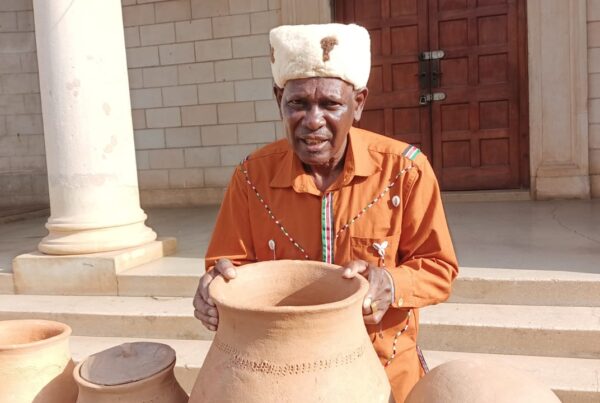
In western Kenya’s sacred Nganyi forest, elders observe the movement of tsiswa ants, wind direction and the delayed flowering of indigenous trees like the muyeye to forecast rainfall patterns — techniques refined over centuries of environmental observation.
Last season, while some modern projections suggested below-average rainfall, local forecasters warned of a false onset followed by intense downpours. Communities that heeded the traditional warnings reportedly adjusted planting schedules and livestock movements accordingly.
As extreme weather events intensify globally, climate experts say such indigenous knowledge systems (IKS) are becoming a critical tool in community-led adaptation.
The Science Behind Indigenous Forecasting
Indigenous forecasting relies on a detailed understanding of ecological patterns — a discipline rooted in phenology, astronomy and behavioural ecology.
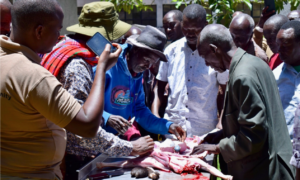
Kenyas President William Ruto immersed in a demonstration for Traditional Weather Forecas
Common indicators used across East Africa include:
- Flowering of indigenous trees such as oloirien among Maasai communities
- Insect and ant migration patterns
- Livestock behaviour and body condition
- Moon phases and star alignments
- Wind direction and cloud formations
Pastoralist communities in Ethiopia’s Afar region, for example, study livestock grazing patterns and celestial movements to determine migration routes during dry seasons. In Kenya and Tanzania, Maasai elders interpret cattle health, tree cycles and seasonal winds to anticipate rainfall variability.
Research referenced by regional climate bodies suggests that in some localised contexts, traditional forecasting in Kenya and Ethiopia has demonstrated up to 94% accuracy in predicting rainfall onset and about 84% accuracy in estimating rainfall volume — particularly at community scale where modern meteorological models often lack granular data.
Bridging Indigenous Wisdom and Modern Meteorology
Regional institutions are now actively integrating indigenous forecasting into formal climate science frameworks.
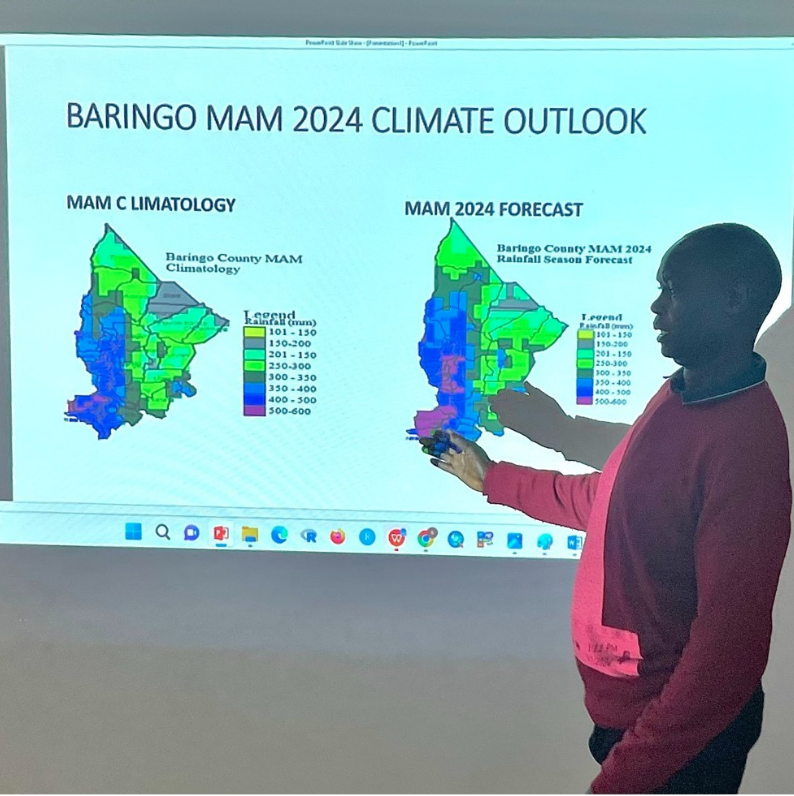
The IGAD Climate Prediction and Applications Centre (ICPAC) has been convening climate outlook forums that combine satellite data, historical weather records and indigenous forecasts to produce more locally relevant seasonal advisories.
Similarly, the Kenya Meteorological Department has increasingly engaged traditional forecasters such as the Nganyi community to complement conventional forecasting models, especially in rural and agricultural zones.
Climate scientists argue that satellites provide broad regional outlooks, while indigenous systems offer micro-level insights rooted in long-term environmental memory.
“This is not about replacing science but enriching it,” several African climate researchers have noted in policy discussions, emphasising that indigenous systems provide historical depth and community trust that technological models alone cannot replicate.
A Regional Pattern Across Africa
The revival of indigenous forecasting is not unique to Kenya.
In Ethiopia, Afar and Oromo pastoralists use star observation and livestock indicators to guide seasonal migration.
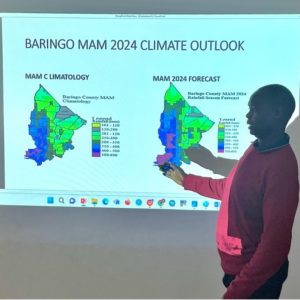
Samuel Mutai , a County Director Meteorological Services in Kenya
In Tanzania, Sukuma and Maasai communities rely on bird migration and plant cycles to anticipate rains.
In parts of West Africa, farmers in Ghana and Burkina Faso observe baobab flowering and wind shifts to predict planting seasons.
These practices are increasingly recognised by development agencies as cost-effective early warning systems, particularly in regions where access to real-time meteorological infrastructure remains limited.
Across the Horn of Africa — one of the regions most vulnerable to climate shocks — blending indigenous knowledge with scientific data is proving vital for managing recurrent droughts and flash floods.
Impact on Farmers, Pastoralists and Diaspora Communities
For millions of smallholder farmers and pastoralists, timely and trusted weather forecasts directly determine food security and income stability.
- Hyper-local forecasts help communities:
- Adjust planting and harvesting calendars
- Plan livestock migration routes
- Prepare for floods or drought cycles
- Protect household food reserves
The impact also extends to diaspora-linked households, many of whom fund farming, livestock and climate adaptation projects through remittances. More accurate seasonal forecasts reduce financial risk and improve planning for families dependent on rain-fed agriculture across East Africa.
Institutionalising Indigenous Knowledge Systems
Regional policymakers are now exploring formal frameworks to preserve and scale indigenous forecasting expertise.
Proposals under discussion within the Intergovernmental Authority on Development (IGAD) include:
- Establishing traditional forecaster networks
- Supporting elder-to-youth knowledge transfer
- Integrating indigenous climate knowledge into school curricula
- Expanding vernacular radio broadcasts that disseminate hybrid forecasts
Experts warn that without documentation and mentorship, much of this ancestral knowledge risks being lost as older custodians age and younger generations migrate to urban centres.
The Future: Hybrid Forecasting for a Warming World
As climate variability increases, experts say the future of weather forecasting in Africa — and potentially other climate-vulnerable regions — lies in a hybrid model that combines indigenous insight with advanced technology.
 In practical terms, this could mean satellite data confirming regional rainfall trends while local forecasters interpret ecological signals to refine village-level predictions.
For global audiences and diaspora communities watching the effects of climate change on their home regions, East Africa’s experience offers a compelling lesson: resilience may depend as much on ancestral environmental wisdom as on modern scientific innovation.
In an era of unpredictable climate extremes, the convergence of stars, trees, animals and satellites is no longer seen as tradition versus science — but as a complementary system shaping one of Africa’s most trusted and culturally grounded climate solutions