By Health Writer | 5484 Media | Nairobi, Kenya
STORY HIGHLIGHTS
- Kenya is strengthening its health and nutrition response through deeper collaboration with the World Food Programme
- The government is scaling up integrated, community-based nutrition interventions under Universal Health Coverage, backed by stronger data and early warning
- Kenya’s adoption of a Nutrient Profile Model marks a major policy shift toward regulating unhealthy foods and tackling diet-related diseases.
Kenya’s health and nutrition agenda is entering a decisive phase, marked by high-level government engagement with humanitarian partners and a parallel push for tougher, evidence-based food policies.
Talks held this week between Health Cabinet Secretary Aden Duale and the World Food Programme (WFP) come against the backdrop of Kenya’s recent adoption of a Nutrient Profile Model (NPM) — a move that positions the country as a regional leader in confronting both acute malnutrition and the growing burden of diet-related noncommunicable diseases (NCDs).
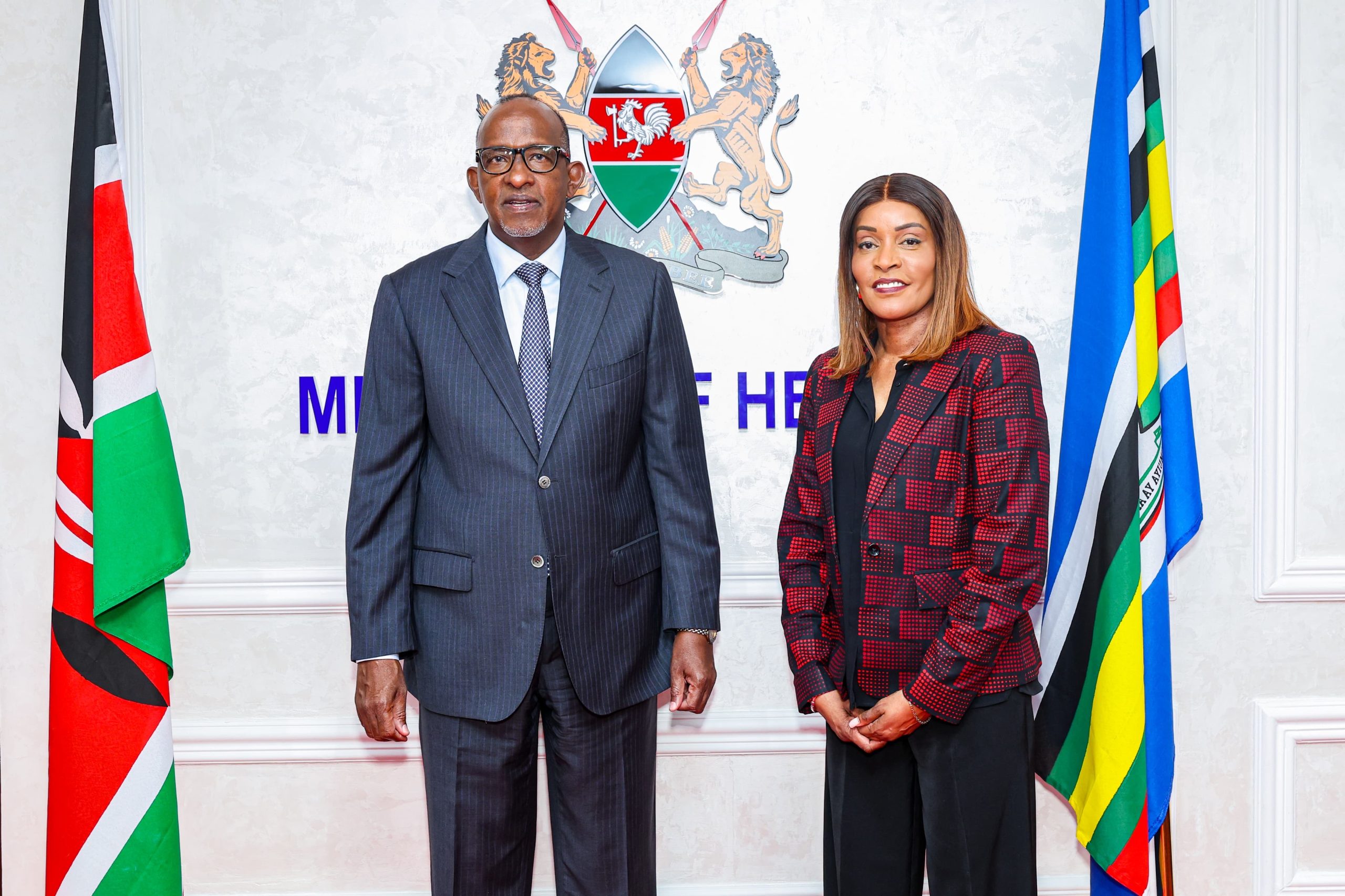
When CS Duale met WFP Country Director Betty Ka at Afya House on 17 December, the focus was firmly on deepening collaboration to protect vulnerable populations, particularly children and pregnant and breastfeeding women in arid and semi-arid regions.
But beyond the courtesy call, the discussions reflected a broader recalibration of Kenya’s nutrition strategy: one that seeks to bridge emergency response, long-term system strengthening, and regulatory reform.
At the operational level, the Ministry of Health outlined a scaled-up, multi-pronged response to nutrition vulnerabilities. This includes tighter surveillance through the Kenya Health Information System (KHIS), the electronic Community Health Information System (eCHIS), and early warning data from the National Drought Management Authority.
Pre-positioning of essential health and nutrition commodities, expansion of integrated outreach services, and deployment of surge capacity in high-risk areas are all being pursued under the Universal Health Coverage (UHC) framework, anchored by more than 107,000 Community Health Promoters delivering services at the last mile.
WFP’s role, as discussed in the meeting, extends beyond food assistance. The agency is increasingly positioned as a strategic partner in anticipatory action, resource mobilisation, early warning, and supply chain resilience — areas that are critical as climate shocks and food insecurity intersect with fragile health systems. Importantly, both sides emphasised strengthening national systems rather than substituting them, signalling a shift toward sustainability and resilience.
This systems-oriented approach mirrors developments on the policy front. Earlier this year, Kenya became the first country in the East African Community to officially adopt a Nutrient Profile Model, a technical but powerful tool that classifies foods based on their nutritional content. The model provides the backbone for policies such as front-of-package warning labels, restrictions on marketing unhealthy foods to children, fiscal measures, and healthier procurement and school feeding standards.
The adoption of the NPM is significant for two reasons. First, it marks a clear government willingness to confront diet-related NCDs — including diabetes, cardiovascular disease, and certain cancers — which are rising rapidly alongside persistent undernutrition. Second, it demonstrates the growing influence of coordinated civil society advocacy in shaping public health policy. A coalition of Kenyan organisations successfully pushed back against an earlier, weaker model that would have allowed high thresholds for sugar, salt, and saturated fat, arguing that such loopholes would undermine public health goals.

The final NPM incorporates evidence-backed standards, including black octagonal “high in” warning labels shown by local research to be effective in discouraging unhealthy food choices. For public health advocates, this represents a turning point: regulation grounded in local data rather than industry-friendly compromises.
Taken together, the WFP engagement and the adoption of the NPM illustrate a more holistic vision of nutrition in Kenya. On one end of the spectrum, the government is strengthening emergency preparedness and community-based responses to wasting and acute malnutrition, including piloting the WHO 2023 Wasting Guidelines to harmonise the management of severe and moderate acute malnutrition. On the other, it is laying regulatory foundations to reshape the food environment and reduce long-term disease risk.
Yet challenges remain. Effective implementation — whether of early warning systems, integrated outreach services, or front-of-package labeling — will require sustained financing, inter-agency coordination, and political resolve in the face of commercial pressure. The planned National Nutrition and Dietetics Policy, discussed during the Duale–WFP meeting, could provide the unifying framework needed to align governance, financing, and service delivery across the nutrition life course.
For now, Kenya’s trajectory is clear. By aligning humanitarian partnerships with robust domestic policy reform, the country is signalling that nutrition is no longer a fragmented issue confined to drought response or donor programmes, but a central pillar of health, economic productivity, and human development. In a region grappling with both hunger and unhealthy diets, Kenya’s next test will be turning these commitments into measurable, equitable gains for its most vulnerable citizens.